
Hernando County Family Court serves as the main judicial office handling family-related legal matters within Hernando County. It deals with disputes involving marriage, children, and domestic responsibilities under Florida law. The court processes cases that affect household relationships and legal parental rights. It functions as a central location for resolving family disputes through formal legal procedures. Many residents rely on this court for structured handling of sensitive family matters.
This family law court in Hernando County processes a wide range of domestic relations court matters linked to family cases. It handles divorce petitions, child custody decisions, visitation schedules, and child support arrangements. The court also reviews paternity claims and issues related to domestic safety orders. Each case follows state-level family law procedures designed for fair legal review. Family cases are reviewed based on submitted evidence, hearings, and legal filings within the county system. The Hernando County Family Court maintains official records that support legal clarity and future case reference.
What Is Hernando County Family Court?
The Hernando County Family Court is a specific division of the local judicial system that manages household and domestic legal issues. It exists to resolve private disputes between family members without criminal penalties. The Hernando County Family Court operates as a dedicated branch of the Florida judicial system. This division focuses on resolving conflicts within households. The domestic relations court handles situations where people need legal intervention for personal matters.
Purpose of the Court
Why does this court exist? Families often experience breakdowns in communication. When parents disagree on custody or spouses dispute assets, they need an official venue. The court provides a safe, orderly environment to settle these disagreements. Judges apply state laws to divide property, assign support, and protect children.
Legal System Structure
The legal system structure separates criminal matters from domestic ones. This separation allows judges to specialize. Family law hearings focus on equity and fairness rather than punishment. The court operates under civil law. This means one person sues another for a specific remedy, like a divorce decree.
Family Court vs. Criminal Court
A criminal court prosecutes people for breaking state laws, seeking penalties like jail time. The domestic relations court does not send people to prison for having a dispute. Instead, this court forces people to follow civil rules. If someone violates a civil order, the court might impose fines or modify custody.
| Feature | Domestic Relations Court | Criminal Court |
|---|---|---|
| Goal | Fair resolution and stability | Punishment and public safety |
| Parties | Spouses, parents, children | State vs. Defendant |
| Outcome | Court orders, decrees | Fines, probation, incarceration |
| Standard | Equity and fairness | Beyond a reasonable doubt |
The court’s jurisdiction covers only private, domestic issues. Judges hear cases involving paternity, adoption, and injunctions. The rules of evidence remain strict, but the atmosphere feels less adversarial than in criminal court. The main goal focuses on resolution and future stability rather than punishment for past crimes. This focus helps families move forward.
Types of Family Cases Handled in Hernando County
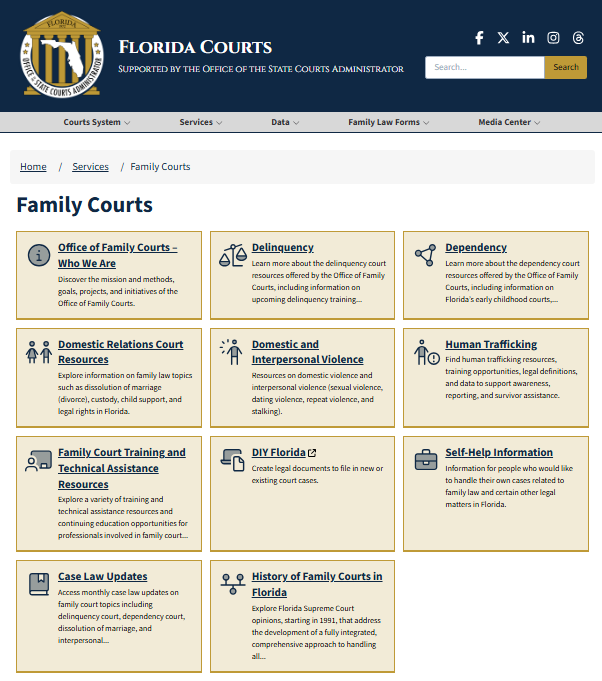
The family law court in Hernando County manages a wide variety of family cases, including divorces, custody battles, and support disputes. Each case type addresses a specific domestic issue that https://www.flcourts.gov/Services/Family-Courts requires a judge’s formal decision. People bring many different family cases to the local courthouse. The family law court in Hernando County has the authority to resolve these specific disputes. Judges oversee matters that impact the daily lives of parents and children.
Dissolution of Marriage
Divorce proceedings make up a large portion of the court docket. A divorce legally ends a marriage. The court divides shared assets and debts. Judges decide on spousal support, known as alimony. They resolve any disputes over marital property. The court must determine if the marriage is irretrievably broken. Florida operates as a no-fault state, meaning neither spouse must prove the other did something wrong. They only need to state that the marriage cannot be saved.
Matters Involving Children
Child custody disputes require judicial intervention when parents cannot agree. The court establishes custody arrangements and dictates where the child lives. Visitation rights outline the time the non-custodial parent spends with the child. The judge always prioritizes the child’s safety and routine. The judge looks at the moral fitness of each parent. They review the child’s school record and community ties. Visitation rights often include specific holiday schedules and summer break arrangements. The court builds a detailed calendar to prevent future arguments.
Financial Support
Child support cases guarantee that both parents contribute financially to raising their children. The court calculates payments based on state guidelines. These guidelines consider each parent’s income and the child’s needs. Child support calculations follow a strict formula. The judge adds both parents’ net incomes together to find the total household income. Then, they subtract health insurance costs and daycare expenses. The non-custodial parent pays a proportional share.
Alimony provides financial support to a lower-earning spouse after a divorce. The court awards alimony based on the length of the marriage and financial disparity. Alimony awards depend on the receiving spouse’s need and the paying spouse’s ability to pay. Judges consider the standard of living established during the marriage. They award temporary, rehabilitative, or permanent alimony depending on the circumstances.
Protection and Care
Guardianship cases give a responsible adult legal authority over a minor or an incapacitated adult. The court reviews the proposed guardian’s background to guarantee they act in the person’s best interest. The court monitors the appointed guardian. The guardian must file annual reports detailing the ward’s condition and finances. This oversight protects vulnerable individuals from exploitation.
Injunctions for protection against domestic violence fall under this court. Judges can order an abusive person to stay away from the victim. Paternity cases establish the legal father of a child born to unmarried parents. This legal determination creates rights for visitation and obligations for support. Adoption cases legally transfer parental rights from the biological parents to the adoptive parents. The court finalizes the adoption after a thorough background check and home study.
Child Custody Cases in Hernando County Family Court
Child custody cases in this court determine where a child lives and how parents make decisions for them. Judges create parenting plans based on the best interest of the child standard. Child custody disputes rank among the most emotionally charged matters in the legal system. Parents often struggle to agree on living arrangements and decision-making authority. The court steps in to create structured parenting plans that serve the child.
Types of Custody Arrangements
The court recognizes two main types of custody: physical and legal. Physical custody determines where the child lives day-to-day. Legal custody gives a parent the right to make major decisions about the child’s education, healthcare, and religion.
- Joint custody: Both parents share physical or legal custody. The child might spend equal time in both homes. Both parents share decision-making power.
- Sole custody: One parent holds the majority of physical time and decision-making power. The court awards sole custody when one parent poses a risk to the child.
Best Interest of the Child Standard
Judges base their court orders on the best interest of the child standard. This legal framework requires the judge to evaluate several factors. They look at each parent’s ability to provide a stable routine. They consider the child’s bond with each parent. The judge reviews any history of domestic violence or substance abuse.
The court evaluates the moral fitness of the parents. They check the child’s wishes if the child is old enough to express a reasonable preference. Judges prefer custody arrangements that allow the child frequent contact with both parents, as long as it remains safe.
Court Evaluation Process
How does the court gather facts? The judge relies on the court evaluation process to uncover the truth.
- Financial Affidavits: Parents must submit financial records to prove they can support the child.
- Parenting Courses: Both parents complete mandatory court-approved parenting classes.
- Guardian Ad Litem: The judge appoints a representative to investigate the family situation and report back to the court.
- Social Investigation: Professionals might visit the parents’ homes, interview the child, and observe the interactions.
These professionals provide objective recommendations to the judge. During the court evaluation process, judges look for cooperation. A parent who badmouths the other parent might lose credibility. Judges want parents who support the child’s relationship with the other parent. This cooperative attitude strongly influences custody arrangements.
Creating Parenting Plans
Florida law requires parents to submit a formal parenting plan. This document outlines the exact custody arrangements and visitation rights. It includes weekly schedules, holiday rotations, and transportation rules. The plan dictates how parents will communicate about the child.
Child Support Process
Child support is a court-ordered financial obligation paid by one parent to another to cover child-rearing expenses. The court calculates the payment amount using state guidelines that consider both parents’ incomes. Raising a child costs a significant amount of money. The state expects both parents to share this financial burden. Child support guarantees that the child’s basic needs receive funding from both sides. The court uses strict guidelines to determine the exact amount.
Income Calculation Method
The income calculation process follows the Florida Statutes. The court adds the net monthly income of both parents. Net income includes salaries, bonuses, commissions, and disability benefits. The court subtracts taxes, health insurance premiums, and union dues.
- Combine Net Incomes: The judge adds both parents’ net incomes to find the total household income.
- Consult State Guidelines: The judge uses a chart to find the baseline support amount for that income level.
- Add Extra Costs: The judge adds costs for daycare, medical expenses, and extracurricular activities.
- Divide Proportionally: Each parent pays a share based on their percentage of the total income. The parent who spends less time with the child pays their share to the other parent.
Payment Structure
The payment structure usually involves monthly or bi-weekly payments. The court often orders an income withholding order. This directs the paying parent’s employer to deduct the support amount directly from their paycheck. This system secures timely payments and reduces missed deadlines. The receiving parent spends the money on the child’s daily needs. This includes housing, groceries, clothing, and school supplies. The court does not track every dollar. They trust the receiving parent to use the funds for the child’s benefit.
Enforcement of Court Orders
What happens if a parent refuses to pay? The court takes enforcement actions very seriously. Failure to pay violates formal court orders. The judge can suspend the parent’s driver’s license or professional licenses. The court might intercept tax refunds or lottery winnings. In extreme cases, the judge can hold the non-paying parent in contempt of court. This can result in jail time until the parent pays the overdue amount. The Department of Revenue often assists with enforcement actions. They track down non-paying parents and garnish their wages directly from their employers.
Modification Requests
Life circumstances change over time. A parent might lose a job or suffer a disabling injury. Modification requests allow parents to adjust the support amount. The parent must file a formal petition with the court. They must prove a substantial, permanent, and involuntary change in income.
A temporary setback does not justify a modification. The court looks for long-term changes. If the child develops special medical needs, the judge might increase the support amount. If the paying parent receives a massive raise, the receiving parent can ask for an increase. The court reviews modification requests carefully. Judges want to maintain consistency for the child. They adjust court orders only when the facts clearly justify a change. Both parents must continue following the existing order until the judge signs a new one. Unilateral decisions to stop paying lead to serious legal consequences.
Divorce Proceedings in Hernando County Family Court
Divorce proceedings legally dissolve a marriage and divide shared assets and debts between spouses. The process requires filing specific legal documents and attending hearings to finalize the separation. Ending a marriage involves a formal legal process. Divorce proceedings address both emotional and financial family disputes. The court oversees the fair division of assets and resolves any disagreements between spouses.
Steps Divorce Process
- Filing for Divorce: One spouse submits a Petition for Dissolution of Marriage to the court.
- Service of Process: The petitioner serves the paperwork to the other spouse. The respondent has twenty days to file an answer.
- Financial Disclosure: Both spouses exchange financial information. They complete mandatory disclosure forms. This guarantees transparency regarding assets, debts, and income.
- Mediation Process: The couple attempts to resolve their differences through court mediation. If they reach an agreement, they submit settlement agreements to the judge.
- Trial: If mediation fails, the case goes to trial. Both sides present evidence and call witnesses. The judge makes the final decisions on contested issues.
Required Documents
Filing requires specific paperwork. The petitioner needs a civil cover sheet, a petition for dissolution, and a financial affidavit. A family law financial affidavit details all income and expenses. Both parties must provide tax returns, bank statements, and pay stubs for the last three months. If children are involved, the parents must complete a parenting course and submit a parenting plan.
Timeline Expectations
How long does the process take? An uncontested divorce, where both spouses agree on everything, can finalize in as little as four to six weeks. Contested family disputes take much longer. They often require six months to a year to resolve. Complex cases involving significant assets or custody battles can take even longer. The court docket and the willingness of both parties to cooperate dictate the speed.
Legal Separation vs. Divorce
Florida does not formally recognize legal separation. Couples can sign a separation agreement to divide assets and live apart, but the court does not grant a separation decree. The marriage remains legally binding until the court finalizes the divorce.
Finalizing the Decree
Once the judge reviews the settlement agreements or makes a ruling at trial, they sign a Final Judgment of Dissolution of Marriage. This document restores both parties to single status. It outlines the terms of the property division, alimony, and custody. Both spouses must adhere to the terms of this judgment. Modifying the decree later requires filing a new motion and proving a significant change in circumstances. The court keeps a record of the final judgment permanently.
How to File a Family Case in Hernando County
Filing a family case requires submitting the correct legal forms to the local clerk of court and paying the required filing fees. The process starts with petition filing and officially opens a court case. Starting a legal action can feel overwhelming. Filing a family case involves a specific series of steps. Residents must follow the rules set by the local judicial system.
Obtain the Correct Legal Forms
The first step requires getting the right paperwork. The Florida Courts website provides all necessary legal forms for family matters. The Hernando County clerk of courts offers forms at the local courthouse. People must select forms specific to their type of case, like divorce or custody.
Complete the Paperwork
Fill out every section of the legal forms accurately. Leave no blanks. If a section does not apply, write “none” or “not applicable.” The petition filing marks the official start of the case. The petitioner must detail what they want the judge to order. They must provide background information about the family.
File with the Clerk of Court
Bring the completed documents to the Hernando County clerk of the court. The courthouse is located in Brooksville. The clerk reviews the paperwork for completeness. They stamp the documents and assign a case number. This number tracks the case through the court jurisdiction.
Pay the Filing Fees
Filing requires payment. Filing fees vary depending on the case type. A divorce petition costs more than a custody modification. Residents who cannot afford the fees can apply for a fee waiver. The clerk provides an application to determine eligibility based on income.
Serve the Other Party
The other party must receive a copy of the filed paperwork. The sheriff’s office or a private process server delivers the documents. They provide proof of service to the court. This proves the respondent knows about the case. Proper service is required for the judge to make valid court orders.
File the Answer
The respondent has a specific timeframe to reply. They must file an answer with the clerk of the court. The answer admits or denies the statements in the petition. Failing to file an answer allows the judge to grant the petitioner’s requests by default.
Managing Court Jurisdiction
Filing a family case in the correct location is critical. The court jurisdiction determines which county hears the case. For divorces, at least one spouse must live in Florida for six months before filing. For custody, the child must have lived in the state for at least six months. Filing in the wrong county delays the process. The court might dismiss the case entirely. Following these steps carefully guarantees the case moves forward smoothly. The clerk of the court provides resources for people representing themselves, but cannot offer legal advice. Self-represented litigants often use the self-help center at the courthouse. The staff reviews completed legal forms to check they meet basic requirements. They check for signatures and proper notarization. Many legal forms require notarization. A notary public verifies the identity of the person signing the document. Banks and the courthouse usually offer notary services. Bringing a valid photo ID is necessary for notarization.
After filing a family case, the court schedules initial hearings. The notice of hearing informs both parties of the date and time. Attending all scheduled hearings is mandatory. Missing a hearing can result in the judge dismissing the case. The court’s jurisdiction strictly governs procedure. The Florida Rules of Civil Procedure dictate how people serve papers, file motions, and conduct discovery. Reading the local administrative orders helps people know specific rules for Hernando County. These orders cover everything from dress code to electronic device usage in the courtroom. Preparation makes the filing process much easier.
Mediation and Settlement in Family Law Cases
The mediation process requires both parties to meet with a neutral third party to resolve family disputes outside the courtroom. It helps families create settlement agreements without needing a judge to decide. Courtrooms create an adversarial environment. The mediation process offers a different approach to resolving family disputes. A neutral mediator leads the conversation between the two parties.
Why Mediation Is Required
Florida courts mandate court mediation for most family law cases. Judges want parents to make their own decisions about their children. When a judge decides, the parents lose control over the outcome. Mediation empowers families to craft their own solutions. It reduces the backlog of cases waiting for trial.
How the Process Works
A trained mediator sits down with both parties. Sometimes, everyone sits in the same room. In high-conflict situations, the parties stay in separate rooms, and the mediator moves between them. The mediator does not take sides or give legal advice. They facilitate discussion and help identify common ground. Both parties state their needs and concerns. The mediator helps them brainstorm options for dispute resolution.
Benefits Before Trial
Reaching a settlement agreement saves significant time and money. Trials require extensive preparation, witness fees, and court costs. Mediation usually takes a few hours. A trial can drag on for days.
- Lower Costs: Mediation fees cost much less than trial attorney fees.
- Faster Resolution: Parties settle disputes in one day instead of waiting months for a trial date.
- Less Stress: The informal setting feels less intimidating than a courtroom.
- Flexible Solutions: People speak openly without strict rules of evidence. Parties can agree to creative arrangements that a judge cannot order.
A successful mediation results in a binding settlement agreement. The judge incorporates this agreement into the final court order. If mediation fails, the case proceeds to trial. The mediator keeps all discussions confidential. Nothing said during mediation can be used as evidence later.
Hernando County Family Court Orders and Enforcement
Hernando County Family Court issues binding court orders that dictate child custody, support, and divorce terms. If someone violates these orders, the court takes enforcement actions to guarantee compliance. Judges issue formal court orders to finalize decisions in family law cases. These orders carry the full weight of the law. Both parties must follow the rules outlined in the document.
Types of Court Orders
The court issues various orders depending on the case. Temporary orders establish rules during the pending case. Final orders permanently resolve the issues.
Orders include:
- Child Support Orders: Dictate the payment amount and schedule.
- Alimony Orders: Require one spouse to pay the other spousal support.
- Parenting Plans: Outline custody arrangements and visitation schedules.
- Injunctions for Protection: Order one person to stay away from another person.
Legal Consequences for Violations
Refusing to comply triggers legal consequences. The wronged party can file a motion for contempt. A judge schedules a hearing to review the alleged violation. If the judge finds that the person willfully violated the order, they face penalties. Ignorance of the order does not excuse a violation. People must read and know every section of their court orders.
Enforcement Actions
The court utilizes various enforcement actions to force compliance. For unpaid child support, the judge can garnish wages or seize bank accounts. For denied visitation, the judge can order makeup parenting time. In severe cases, the judge can order the non-compliant person to pay the other side’s attorney fees. The court might even impose jail time for civil contempt until the person agrees to follow the order.
Sometimes, a person violates an order accidentally. For instance, a parent might arrive late for a custody exchange due to traffic. The court distinguishes between minor infractions and willful disobedience. Willful disobedience means the person purposefully ignores the rules.
Hernando County Family Court Location and Jurisdiction
The family law court in Hernando County is located in Brooksville and handles domestic cases for residents living within the county’s boundaries. The circuit court system manages these local legal matters. Finding the right courthouse is necessary for attending hearings and filing documents. The family law court in Hernando County operates out of a specific facility in the county.
Courthouse Location
The main courthouse location sits at 20 N Main St, Brooksville, FL 34601. People file their petitions and attend hearings at this address. The clerk of the court operates on the first floor to assist with paperwork and fee payments. The building features courtrooms on the upper floors where judges conduct hearings.
- Address: 20 N Main St, Brooksville, FL 34601
- Clerk Hours: Monday – Friday, 8:00 AM – 5:00 PM
- Parking: Free public parking surrounds the building
- Security: Visitors must pass through metal detectors
Jurisdiction Boundaries
The court only handles cases that fall within its jurisdictional boundaries. People must file their case in the county where they live. For divorce, the filing spouse must reside in Hernando County. For custody, the child must primarily reside within these borders. Filing in the wrong location causes delays and dismissed cases. The jurisdiction boundaries follow the geographical lines of Hernando County. This includes the cities of Brooksville and Weeki Wachee.
The Circuit Court System
Florida’s circuit court system manages family law matters. Hernando County belongs to the Fifth Judicial Circuit. This circuit includes several neighboring counties. The governor appoints circuit judges to oversee domestic relations cases. These judges have the authority to issue final orders and decrees.
The Fifth Judicial Circuit website provides detailed maps and directions. The website lists the specific judges assigned to the family division. It posts the daily court docket. Parking is available around the courthouse location, but it can fill up quickly during busy mornings. Arriving early guarantees time to pass through security. The courthouse requires valid photo identification for entry. People must turn off their cell phones before entering the courtroom. The circuit court system guarantees residents have local access to justice. They do not need to travel far to resolve their domestic issues. The court serves the community by providing a safe place to settle disputes.
Hernando County Family Court FAQs
People frequently ask about custody duration, filing timeframes, court appearance requirements, and whether they need a lawyer. The court provides specific rules and timelines for each of these common concerns.
How Long Does a Custody Case Take?
Custody duration varies based on the level of conflict. An uncontested case where parents agree takes a few months. A contested case requiring a trial can take six months to a year. The court evaluation process and scheduling affect the timeline.
What Is the Filing Time for a Divorce?
Florida requires a twenty-day waiting period after serving the divorce petition. If the couple has minor children, the court might require a longer period to complete parenting classes. Uncontested divorces finalize quickly after the waiting period ends. Contested divorces take several months to reach a trial date.
Do I Have to Appear in Court?
Court appearance requirements depend on the type of case. Uncontested divorces might only require a brief virtual hearing. Contested cases require both parties to appear in person for multiple hearings. People must attend all scheduled hearings. Missing a court date results in the judge dismissing the case or ruling against the absent party.
Do I Need a Lawyer for Family Court?
Florida law allows people to represent themselves. This is called appearing “pro se.” A lawyer is not legally required. Family court involves complex laws and strict procedures. Hiring an attorney protects a person’s rights. An attorney handles the paperwork, negotiates settlements, and presents evidence effectively. People with simple, uncontested cases often manage without a lawyer. Anyone facing a contested trial should seek legal counsel.
How Are Assets Divided in a Divorce?
Florida follows equitable distribution laws. The court divides marital assets and debts fairly, though not necessarily equally. The judge considers factors like the length of the marriage and each spouse’s economic circumstances. Separate property owned before the marriage remains with the original owner.